
Caturra: the compact variety behind a lot of great coffee
A natural Bourbon mutation from Brazil, Caturra is one of Latin America's workhorse varieties — clean, sweet and balanced. Here's what to expect in the cup, and where to find it.
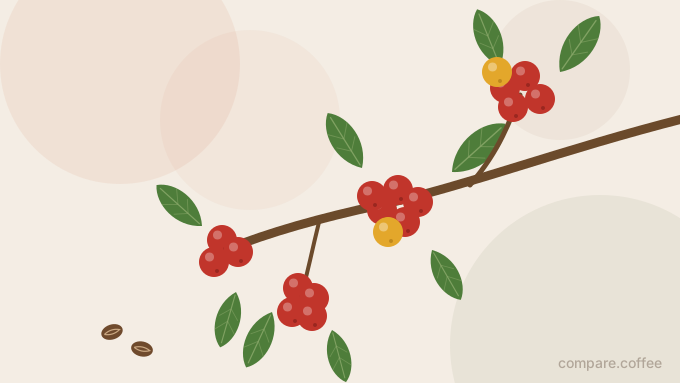
Caturra is one of the most widely planted coffee varieties in Latin America. If you drink specialty coffee from Colombia, Costa Rica or Central America, you've almost certainly tasted it. Farmers like it for its high yield and compact size; drinkers like it for a clean, sweet, balanced cup.
Where it comes from
Caturra is a natural mutation of Bourbon, discovered on a Brazilian farm in the early 1900s. A single gene makes the plant short and bushy — a "dwarf" variety — so trees can be planted closer together and picked more easily. That productivity is a big reason it spread across Colombia, Costa Rica, Honduras, Guatemala and beyond.
How it tastes
At its best, Caturra is bright and clean: gentle citrus acidity, caramel-like sweetness and a medium body. It rarely shouts the way a Geisha or a wild natural can, but that balance is the point — a dependable cup that lets origin and processing show through. Washed Caturra leans crisp and sweet; honeys and naturals add more fruit and weight.
Good to know when buying
Caturra is highly susceptible to coffee leaf rust, so many farms have shifted to hardier descendants such as Catuaí and Castillo, which carry Caturra in their lineage. When a roaster calls out "Caturra" on the bag, it often signals a producer who has chosen flavour and tradition over the easier-to-grow hybrids — usually a good sign for the cup.
Below are current coffees from our catalogue where Caturra commonly appears — Colombian and Central American lots, washed processes and strong value picks. Everything is priced per 100g so you can compare like for like.
Caturra coffees
See all →- UK
Potterbeans
Co-Ferment speciality Twin Pack
colombiaespresso120g£23.00(£19.17/100g)Checked 4d ago - UK
Casa Espresso
Edinson Argote Co-Ferment
colombia250g£18.50(£7.40/100g)Checked 4d ago - UK
Casa Espresso
Colombia Tatacoa
chocolate, stone fruit, caramel
colombia250g£11.95(£4.78/100g)Checked 4d ago - EU
Carrow Coffee
LA PLATA (DECAF) – ESPRESSO – FILTER — Carrow Coffee Roasters
colombia250g€13.50(€5.40/100g)Checked 4d ago
Best value
See all →- UK
White Rose Coffee Roasters
Ethiopian Limu Natural Arabica Roasted Coffee
location, origin
ethiopiamediumSCA 871000g£19.99(£2.00/100g)Checked 4d ago - UK
White Rose Coffee Roasters
Guatemala Erika Sanchez Washed Arabica Roasted Coffee
location, origin
guatemalamediumSCA 871000g£21.20(£2.12/100g)Checked 4d ago - UK
White Rose Coffee Roasters
Colombian Natural Flor Del Desierto Arabica Roasted Coffee
location, origin
colombiamediumSCA 861000g£19.99(£2.00/100g)Checked 4d ago - UK
White Rose Coffee Roasters
Rwanda Gasharu Estate Arabica Roasted Coffee
location, origin
rwandamediumSCA 861000g£23.50(£2.35/100g)Checked 4d ago